
Earlier this year (2025), I went to an anime convention called Zenkaikon. It was my first time spending an entire weekend at a con, and I was excited. One thing I was especially looking forward to was the Ribbon Game.1 There’s nothing that gets my Crow Brain more excited than collecting fun trinkets, so I obviously wanted to participate.
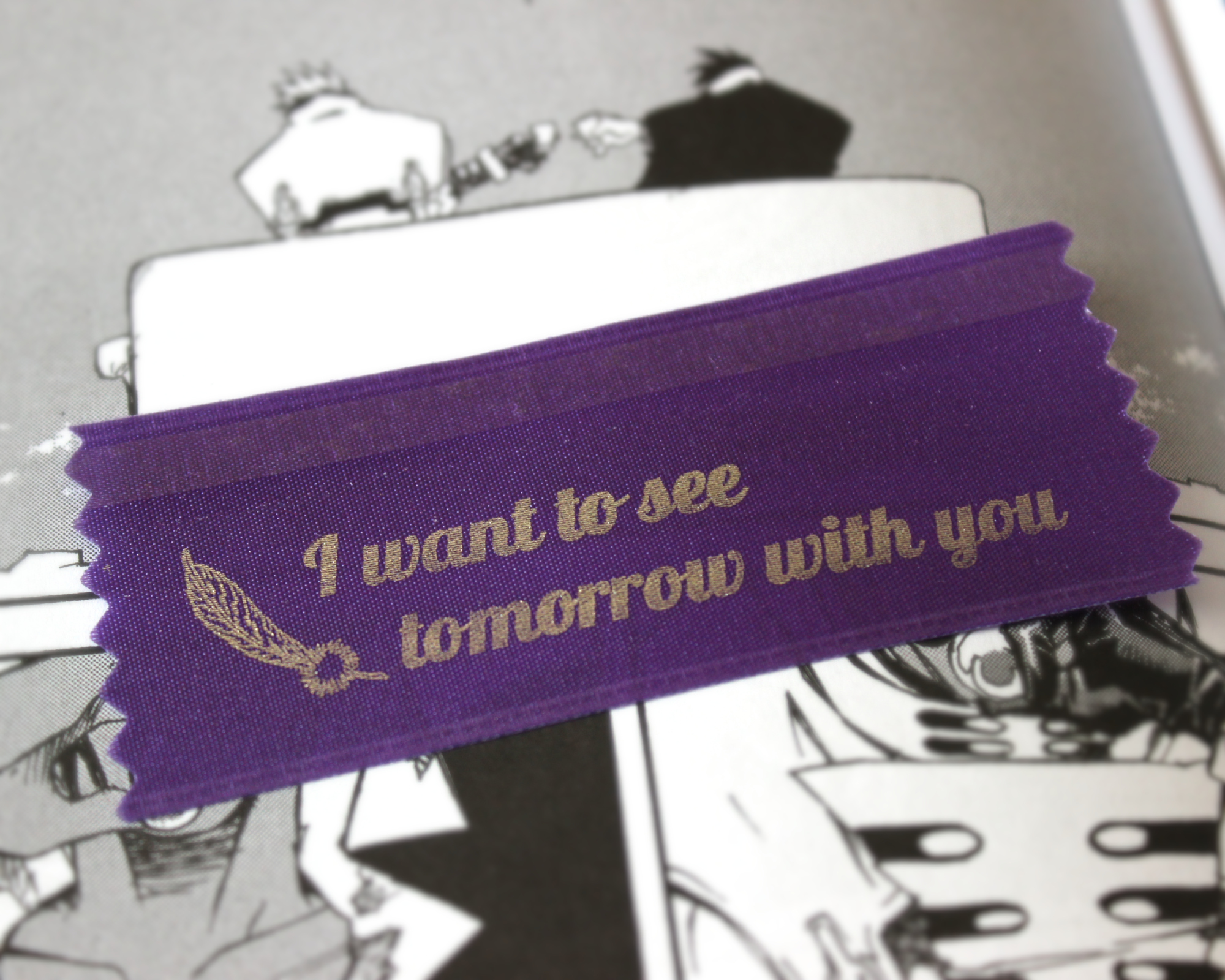
I designed and ordered two different ribbons, both of them inspired by the Trigun franchise. One was specifically for cosplayers and fans, but I wanted something else that others would appreciate even if they didn’t “get” the reference. I borrowed one of the series’s most memorable quotes and put a twist on it: “I want to see tomorrow with you.”
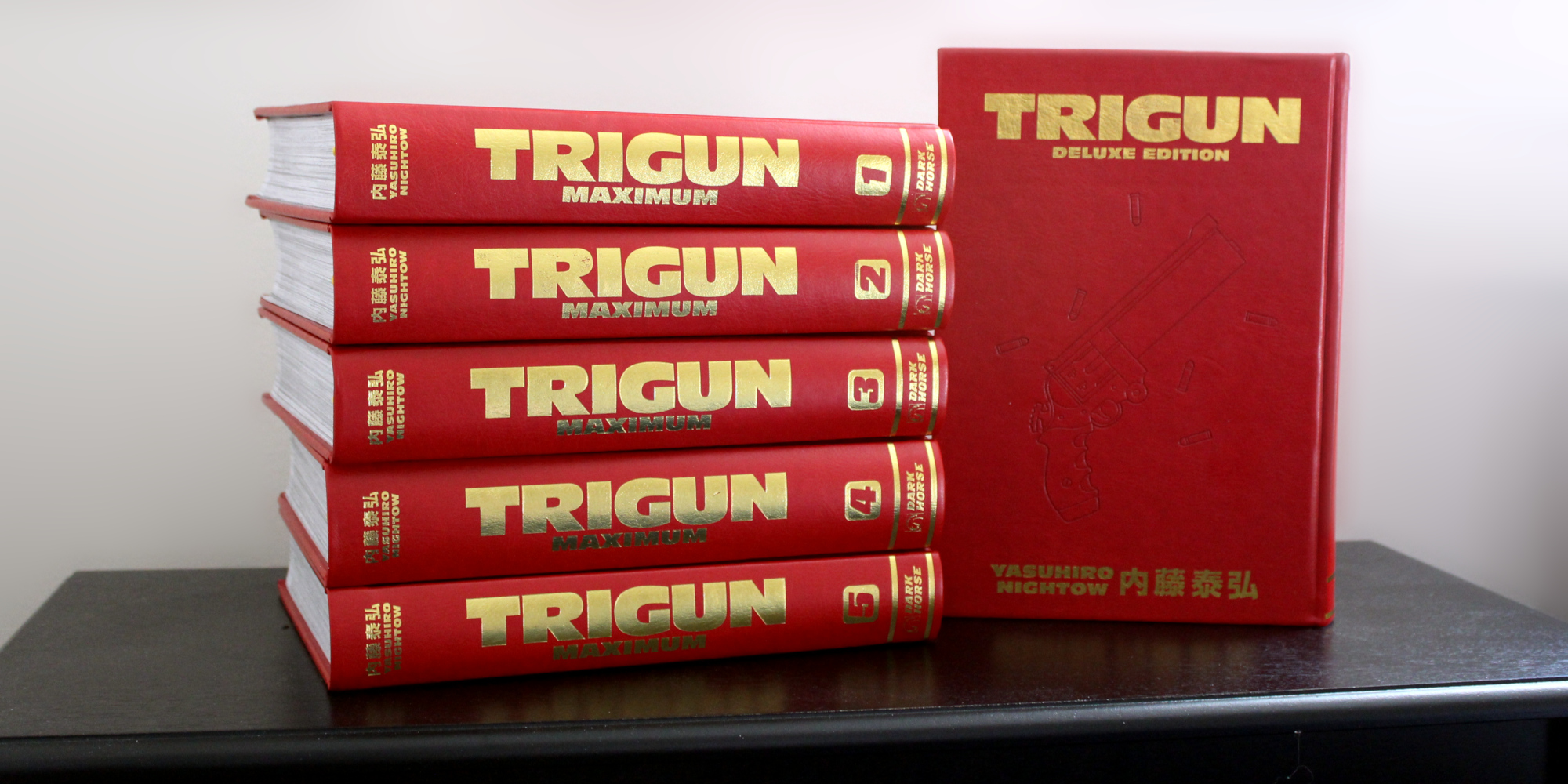
Some context: about a year prior, I read the manga Trigun Maximum by Yasuhiro Nightow. I had wanted to read the series ever since I watched its two anime adaptations, but until recently, it was out of print in the United States. Fortunately, some fans had started creating their own English translation called Trigun Ultimate Overhaul2, and it was thanks to them that I was finally able to enjoy the series.

Trigun takes place in the distant future, on a desert planet not so affectionately called No Man’s Land. The story follows Vash the Stampede, a gun-slinging outlaw with a bounty of sixty billion on his head. Sounds like your typical space western, right? I mean, Vash even has the dramatic badass coat to fit the part.
Here’s the thing though: Vash is a pacifist.
Even with the countless bounty hunters coming after him, Vash rarely defends himself. It’s not that he can’t fight back, but that he chooses not to. Over and over we see him fire his gun to protect the people around him, but never for himself. And Vash’s choice isn’t without consequence: underneath that flashy coat, his body is covered in scars from people who wished him harm.

Vash is joined in his travels by Meryl Stryfe and Milly Thompson, insurance agents who are tasked with cataloging the disasters that follow him; and Nicholas D. Wolfwood, an itinerant priest with a few secrets of his own. These characters vary slightly between the manga, the 1998 anime, and the 2023 anime, but in every version, they play a vital role in the story and are people that Vash values dearly.3


Trigun is a story filled with complex characters, layers of symbolism, and themes that are deeply intertwined with the plot. It is also a story filled with heartbreak and grief – which is why it’s sometimes hard to recommend to others. Trigun doesn’t shy away from the painful aspects of being human – it accepts them, even embraces them. It is both devastating and fulfilling. It takes you to some dark places, but it pulls you through them.
There is so much more to unpack about Trigun that it would take a dozen blog posts for me to get to it all. And perhaps I’ll write those one day too, but for now, let’s return to the quote I was talking about.
(spoiler territory begins below)

Volume 10 of Trigun Maximum finds Vash and Wolfwood in the midst of a major battle against a powerful enemy. When the situation starts getting dire, Vash has a moment of realization. He’s always considered Wolfwood a friend and ally, but he’s become even more than that. The official English translation from Dark Horse Comics (Justin Burns) reads, “After all was said and done, I wanted to spend my tomorrows with him.” The Ultimate Overhaul fan translation, however, phrases it a little differently: “I wanted to see tomorrow with him.”
Both translations express the same sentiment of deep love for someone else. While the official translation is quoted most often, I personally prefer the Overhaul translation, where the focus is on Vash’s hope. He says, “I want to see tomorrow, I want to live to fight another day. And I want you to be there too.”


– Vash, Trigun Maximum Vol. 10
Lately it’s been hard for me to be hopeful. Every time I turn around, there’s another article or news report about how people like me and the people I love are in danger.
In just 2025 alone, disabled and neurodivergent people have already been called a “dire threat to the American people and [their] way of life” by the White House (Archive). Masked law enforcement is pulling people off of the streets in broad daylight, something I thought only happened in political thrillers and dystopian novels. Immigration agents are conducting raids across the country, detaining people including legal residents and U.S. citizens. Queer and trans people are fighting for their right to exist against a society that seems bent on destroying them. Powerful people are making Nazi salutes on live television and no one is stopping them.
These fears hit close to home too. It was just over a year ago that I was in a mental health treatment program, which consisted of therapy and psychiatric medication. Now I’ve learned that the current Secretary of Health believes that antidepressants are “addictive” and contribute to gun violence. I’m worried that I’ll lose the medicine that literally gave me my life back.
For years I wanted to be a librarian, but between book banning campaigns and the Institute of Museum and Library Services being gutted, I wonder if that’s even a viable career path anymore. And if I can’t find a new job before my current one ends, how will I pay for the healthcare I need when Medicaid funding just got slashed?
I finally feel confident as a queer person and I want to express that part of my identity after keeping it close for years. Now I find myself over-analyzing new situations, even ones as mundane as going to the public library. I wonder if it’s safe for me to be myself or if I’m putting a target on my back.
In a lot of ways, it feels like having a bounty on my head.
I find Vash relatable for many reasons, but recently, I’ve been thinking a lot about how he hopes. One way it shows up is in how Vash chooses to see the best in others. He has faith that humanity can be good, even when he encounters situations that challenge that belief. I, on the other hand, spiral into despair more often than I’d like. I’m still learning how to believe in goodness and justice, even if most days I’m holding onto it with a white-knuckled grip.
I also see Vash’s hope in the way he thinks about the future – specifically his future. Vash is the archetype of a martyr. He puts himself on the line for others constantly, often at a great personal cost. It’s not a bad trait, but even selflessness can become dangerous in excess. Very rarely does Vash consider what he wants for himself. He won’t allow it – others must come first.

What makes that scene in Vol. 10 so remarkable is that it’s one of the few times Vash expresses a desire that is purely his own. He has always been willing to die for others, but now he’s found something (or rather, someone) that he wants to live for. It’s a rare moment of “selfishness” for this martyr. He wants to live to see tomorrow. And he wants the people he loves to be there too.
In the end, Vash doesn’t get his wish. The battle is won, but at the cost of Wolfwood’s life, and Vash mourns him with a level of emotion we’ve not seen from him before.

I realize this seems like a terrible way to end an essay about hope. If you were looking for some kind of “love conquers all” moral here… sorry. But bear with me for just a few more minutes.
Eight years ago, I wrote about why I enjoy the “classic” Good vs. Evil formula, which boiled down to “It’s nice to have stories that give you hope.” Though I had written it earlier in the year, I didn’t post it until a few months later, after I lost a close family member. I remember how shaky the world felt then: I was finishing my first year of college, turning 19, and trying to navigate grief at the same time. Very few things felt certain, but I knew that when I turned on Breath of the Wild, I would find a world where courage and justice prevailed. There are times when we need stories like that, the ones that hold their hands out and encourage us to get back on our feet.4
But sometimes we need the stories that meet us in our pain. The stories that kneel beside us and say yeah, it sucks. You wanted it to be different, but it’s not, and it’s okay to grieve that. But don’t let it destroy you. Don’t let it take the good things away from you.
That’s the kind of story Trigun is to me. Vash isn’t naive, he knows the odds are stacked against him, but he dares to hope anyway. He may suffer, he may lose people dear to him, but he never loses his faith in humanity. To some it might seem foolish – why hope for a better tomorrow that might never come? – but I see it more as resilience. Despair is tempting, and to constantly fight against it is a special kind of strength.
So yes, in context, it’s an odd quote to look to for inspiration. It probably wouldn’t be someone’s first choice for turning into a convention ribbon. To me though, it’s a reminder to hope and fight for the future, no matter how bleak things are now. When I think about all the different people I met at Zenkaikon, I wonder how many of them needed that reminder too.
I’m not perfect. There are still days when despair gets the upper hand. But hope is a muscle – it takes time to grow stronger. So like Vash, I will choose to believe in tomorrow. I will choose to believe that there are better days on the other side of the present moment. And I’m going to bring the people I love with me. I will fight with everything I have to bring them with me.
We will see tomorrow together.

– Wolfwood, Trigun Maximum Vol. 10
Notes
- This post isn’t really about Ribbon Games, but if you’re curious and want to know more about them, Colossalcon is known for its massive Ribbon Game and has a comprehensive FAQ. ↩︎
- All manga images are from the Ultimate Overhaul translation unless stated otherwise. Used with permission. (Thank you!) ↩︎
- The 2023 Trigun Stampede anime is the most unique: Meryl is a rookie reporter teamed up with a jaded mentor named Roberto, Wolfwood is an undertaker, not a priest, and Milly doesn’t appear at all (though it’s expected she will be in the sequel series). This post focuses on the Trigun Maximum manga, so assume I’m referring to that unless otherwise noted. ↩︎
- Yes, this post is still available on my blog despite the fact that my old writing style makes me cringe. I would probably approach the subject differently now than I did eight years ago, but I still stand by the overall argument that these types of stories can be a vital source of strength and comfort. ↩︎
Comments
One response to “I Want to See Tomorrow With You”
Always enjoy your writing. Easy to read with enough detail to not overwhelm a neophyte like myself. Keep up the good work!